

🚨 **BREAKING: TAIWAN IS CRACKING DOWN ON AI CHIP EXPORTS TO CHINA!** 🇹🇼🇨🇳🇺🇸
The global AI race just took another major turn! 🤯
Taiwan is preparing to tighten restrictions on advanced AI chip exports to China, aligning its policies more closely with the United States.
🔥 **Here's why this is a BIG deal:**
🔹 **Stricter AI Chip Controls:** Taiwan plans to restrict exports of advanced semiconductors and AI servers.
🔹 **Criminal Penalties:** Unauthorized shipments of restricted AI hardware to China could become a criminal offense.
🔹 **US–China Tech Rivalry:** The move strengthens Taiwan's alignment with Washington as competition for AI dominance intensifies.
🔹 **Global Supply Chain Impact:** Companies such as Nvidia and TSMC operate at the heart of an increasingly sensitive semiconductor industry.
📈 **What does this mean for investors?**
With AI chips powering everything from data centers to advanced robotics, tighter export restrictions could reshape competition, supply chains, and semiconductor investment strategies.
🌎 The battle for AI dominance isn't just about technology anymore — it's about geopolitics, trade, and economic power.
💬 **BIG QUESTION: Will these restrictions strengthen America's AI advantage, or accelerate China's push to develop its own advanced chips?**
🔗 Source: [Yahoo Finance](https://finance.yahoo.com/technology/ai/articles/taiwan-curb-ai-chip-exports-054957385.html)
#AI #Nvidia #TSMC #Semiconductors #Taiwan #China #ArtificialIntelligence #TechNews #StockMarket #Geopolitics #Investing
The global AI race just took another major turn! 🤯
Taiwan is preparing to tighten restrictions on advanced AI chip exports to China, aligning its policies more closely with the United States.
🔥 **Here's why this is a BIG deal:**
🔹 **Stricter AI Chip Controls:** Taiwan plans to restrict exports of advanced semiconductors and AI servers.
🔹 **Criminal Penalties:** Unauthorized shipments of restricted AI hardware to China could become a criminal offense.
🔹 **US–China Tech Rivalry:** The move strengthens Taiwan's alignment with Washington as competition for AI dominance intensifies.
🔹 **Global Supply Chain Impact:** Companies such as Nvidia and TSMC operate at the heart of an increasingly sensitive semiconductor industry.
📈 **What does this mean for investors?**
With AI chips powering everything from data centers to advanced robotics, tighter export restrictions could reshape competition, supply chains, and semiconductor investment strategies.
🌎 The battle for AI dominance isn't just about technology anymore — it's about geopolitics, trade, and economic power.
💬 **BIG QUESTION: Will these restrictions strengthen America's AI advantage, or accelerate China's push to develop its own advanced chips?**
🔗 Source: [Yahoo Finance](https://finance.yahoo.com/technology/ai/articles/taiwan-curb-ai-chip-exports-054957385.html)
#AI #Nvidia #TSMC #Semiconductors #Taiwan #China #ArtificialIntelligence #TechNews #StockMarket #Geopolitics #Investing
1

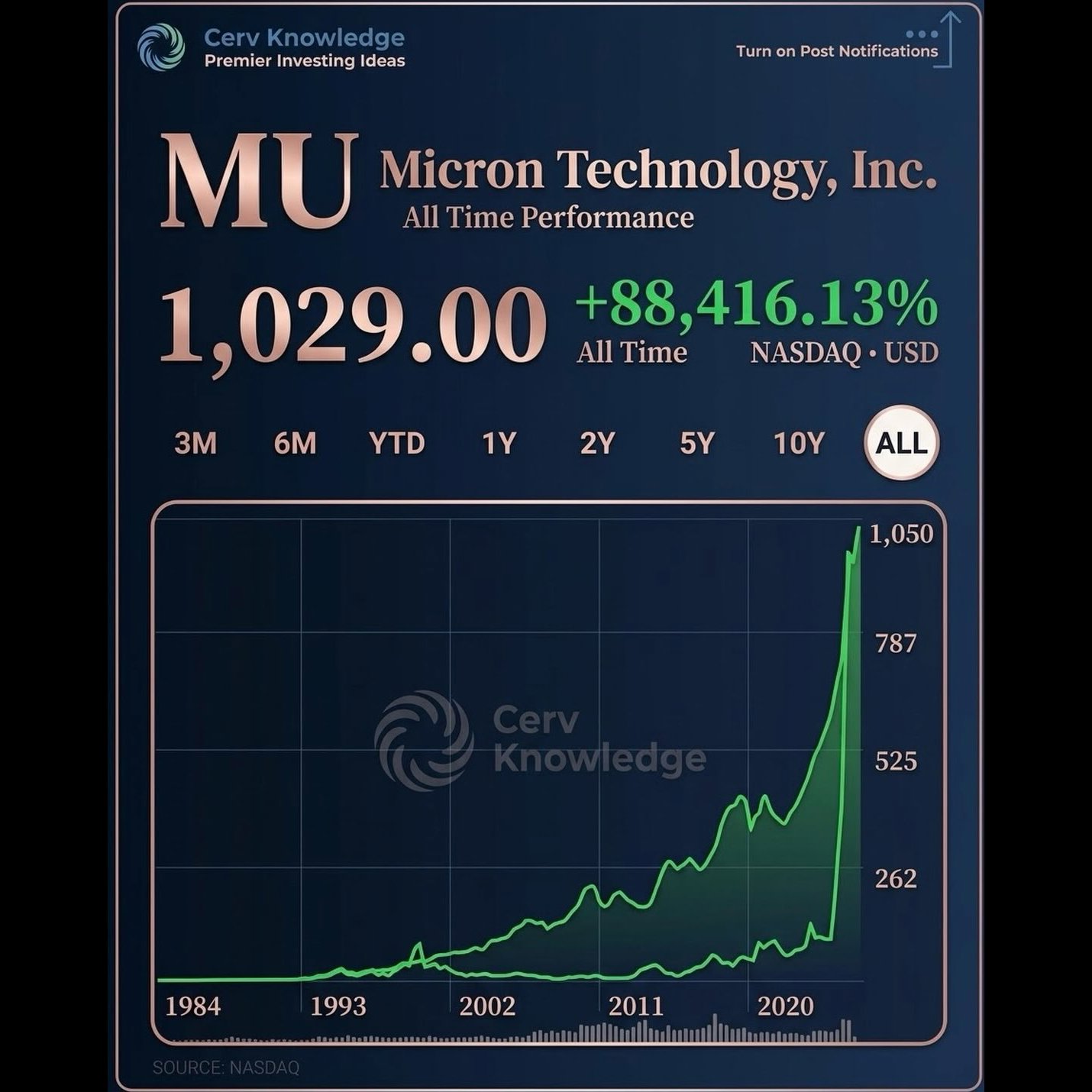
Micron Technology (MU) is becoming one of the biggest beneficiaries of the AI memory boom.
Bank of America expects memory chip sales to nearly double from $937 billion in 2026 to approximately $1.8 trillion by 2030. The firm also maintains a Buy rating and a $1,550 price target on Micron, suggesting more than 50% potential upside.
As companies expand AI data centers, demand for high-bandwidth memory (HBM), DRAM and other memory products continues to grow.
Are you buying, holding or selling MU? What’s your price target?
#Micron #MU #Semiconductors #ArtificialIntelligence #stockmarket
Bank of America expects memory chip sales to nearly double from $937 billion in 2026 to approximately $1.8 trillion by 2030. The firm also maintains a Buy rating and a $1,550 price target on Micron, suggesting more than 50% potential upside.
As companies expand AI data centers, demand for high-bandwidth memory (HBM), DRAM and other memory products continues to grow.
Are you buying, holding or selling MU? What’s your price target?
#Micron #MU #Semiconductors #ArtificialIntelligence #stockmarket

🚀 AI is becoming an economic force, not just a technology trend
The latest signals from the global tech economy are hard to ignore.
📈 Trade in AI-related products — including semiconductors and industrial equipment — surged *42% year over year* in Q1 2026, far outpacing growth in non-AI goods.
💻 At the same time, the global chip race is accelerating. Huawei is pushing ahead with new AI processors as companies and countries compete for computing power, infrastructure and technological independence.
💰 The bigger story? AI investment is now influencing global trade, manufacturing, capital spending and financial markets.
The next phase of the AI boom may be less about who builds the smartest chatbot — and more about who controls the chips, energy, data centers and supply chains powering the technology.
*AI is rapidly becoming infrastructure for the global economy.*
#AI #Technology #Economy #TechNews #ArtificialIntelligence #Semiconductors #Innovation #Business
The latest signals from the global tech economy are hard to ignore.
📈 Trade in AI-related products — including semiconductors and industrial equipment — surged *42% year over year* in Q1 2026, far outpacing growth in non-AI goods.
💻 At the same time, the global chip race is accelerating. Huawei is pushing ahead with new AI processors as companies and countries compete for computing power, infrastructure and technological independence.
💰 The bigger story? AI investment is now influencing global trade, manufacturing, capital spending and financial markets.
The next phase of the AI boom may be less about who builds the smartest chatbot — and more about who controls the chips, energy, data centers and supply chains powering the technology.
*AI is rapidly becoming infrastructure for the global economy.*
#AI #Technology #Economy #TechNews #ArtificialIntelligence #Semiconductors #Innovation #Business
1
🚀 Nvidia just gave the AI rally another shot of adrenaline.
Shares jumped more than 7% after the chip giant delivered blockbuster earnings and signaled that AI demand remains exceptionally strong.
The headline numbers are hard to ignore:
• Nvidia expects 70% revenue growth in fiscal 2028
• AI Cloud, industrial and enterprise sales reached $40.3B, up 138% YoY
• Micron, Marvell, Arm, Intel and AMD all rallied alongside Nvidia
• Jensen Huang says AI has reached an “inflection point”, with more frontier labs, startups and enterprises building massive GPU clusters
But there’s a catch: demand may be growing faster than Nvidia can supply.
TSMC capacity and memory shortages remain constraints, while custom AI chips from hyperscalers and AI labs are becoming a more serious competitive threat.
And Nvidia may be expanding far beyond hardware. Reports say the company has agreed to acquire Hugging Face for $12.9B — a move that, if completed, could give Nvidia an even stronger position across the AI software and open-model ecosystem.
The bigger takeaway: investors are betting that the AI infrastructure boom still has significant runway.
#Nvidia #NVDA #ArtificialIntelligence #AI #Semiconductors #TechStocks #Investing #Technology
Shares jumped more than 7% after the chip giant delivered blockbuster earnings and signaled that AI demand remains exceptionally strong.
The headline numbers are hard to ignore:
• Nvidia expects 70% revenue growth in fiscal 2028
• AI Cloud, industrial and enterprise sales reached $40.3B, up 138% YoY
• Micron, Marvell, Arm, Intel and AMD all rallied alongside Nvidia
• Jensen Huang says AI has reached an “inflection point”, with more frontier labs, startups and enterprises building massive GPU clusters
But there’s a catch: demand may be growing faster than Nvidia can supply.
TSMC capacity and memory shortages remain constraints, while custom AI chips from hyperscalers and AI labs are becoming a more serious competitive threat.
And Nvidia may be expanding far beyond hardware. Reports say the company has agreed to acquire Hugging Face for $12.9B — a move that, if completed, could give Nvidia an even stronger position across the AI software and open-model ecosystem.
The bigger takeaway: investors are betting that the AI infrastructure boom still has significant runway.
#Nvidia #NVDA #ArtificialIntelligence #AI #Semiconductors #TechStocks #Investing #Technology
Grafico NVDA
di TradingView
1


Foxconn is riding the AI wave 🤖📈
Taiwan’s tech giant reported a 35% jump in Q2 profit, reaching around $1.86 billion and beating analyst expectations. 💰
🔥 AI is becoming a bigger part of the business:
• AI servers and cloud/networking made up 51% of Q2 revenue — a new high
• Strong AI demand is expected to continue through the rest of 2026
• Next-generation Nvidia Vera Rubin AI servers are expected to enter mass production preparations in Q3, with shipments starting in Q4
• Foxconn plans to increase capital spending by 30% this year to support growth
🌎 The company is also expanding its global manufacturing footprint, with investments in India, Mexico and Texas, while continuing to explore opportunities in electric vehicles. 🚗⚡
The AI infrastructure boom is clearly becoming a major growth engine for Foxconn — but chip supply and advanced packaging capacity could be key factors shaping the market next year. 👀
#Foxconn #AI #ArtificialIntelligence #Nvidia #AIInfrastructure #Tech #Semiconductors #Investing #Technology #CloudComputing #Taiwan #Innovation
Taiwan’s tech giant reported a 35% jump in Q2 profit, reaching around $1.86 billion and beating analyst expectations. 💰
🔥 AI is becoming a bigger part of the business:
• AI servers and cloud/networking made up 51% of Q2 revenue — a new high
• Strong AI demand is expected to continue through the rest of 2026
• Next-generation Nvidia Vera Rubin AI servers are expected to enter mass production preparations in Q3, with shipments starting in Q4
• Foxconn plans to increase capital spending by 30% this year to support growth
🌎 The company is also expanding its global manufacturing footprint, with investments in India, Mexico and Texas, while continuing to explore opportunities in electric vehicles. 🚗⚡
The AI infrastructure boom is clearly becoming a major growth engine for Foxconn — but chip supply and advanced packaging capacity could be key factors shaping the market next year. 👀
#Foxconn #AI #ArtificialIntelligence #Nvidia #AIInfrastructure #Tech #Semiconductors #Investing #Technology #CloudComputing #Taiwan #Innovation