Crypto can fill itself in. The rest, people type by hand.
Postat de Elena-Octavia Mateescu, 2026-11-18

A flat has no API. A gold coin in a drawer doesn't either, and neither does a share in a friend's company. If you want any of them in a portfolio tracker, you type it in yourself: an amount, a currency, maybe a name and a date.
Crypto is the one exception on TOKERO. Balances on our exchange appear in the tracker on their own, and a MetaMask wallet can be imported. For every other kind of holding there is no import at all, so each one is a row somebody decided was worth typing.
That changes what a count of holdings can tell you. The rows that arrive on their own tell you who has an exchange account. The rows people type tell you what they actually wanted to see.
What I counted
I'm a developer at TOKERO, a social network about money, and I have access to the numbers behind its portfolio tracker. On 17 November I counted every holding currently in a portfolio. No names, no amounts per person: a count of rows per category, and a count of the profiles they belong to. I count profiles rather than people, because a portfolio belongs to a profile.
The first thing the count showed was how lopsided the two kinds of rows are. 4,907 holdings were filled in automatically from exchange balances, on 1,645 profiles. 595 were typed in by hand, on 289 profiles. Roughly eight rows arrive on their own for every one somebody types.
The rest of this article is about the 595.
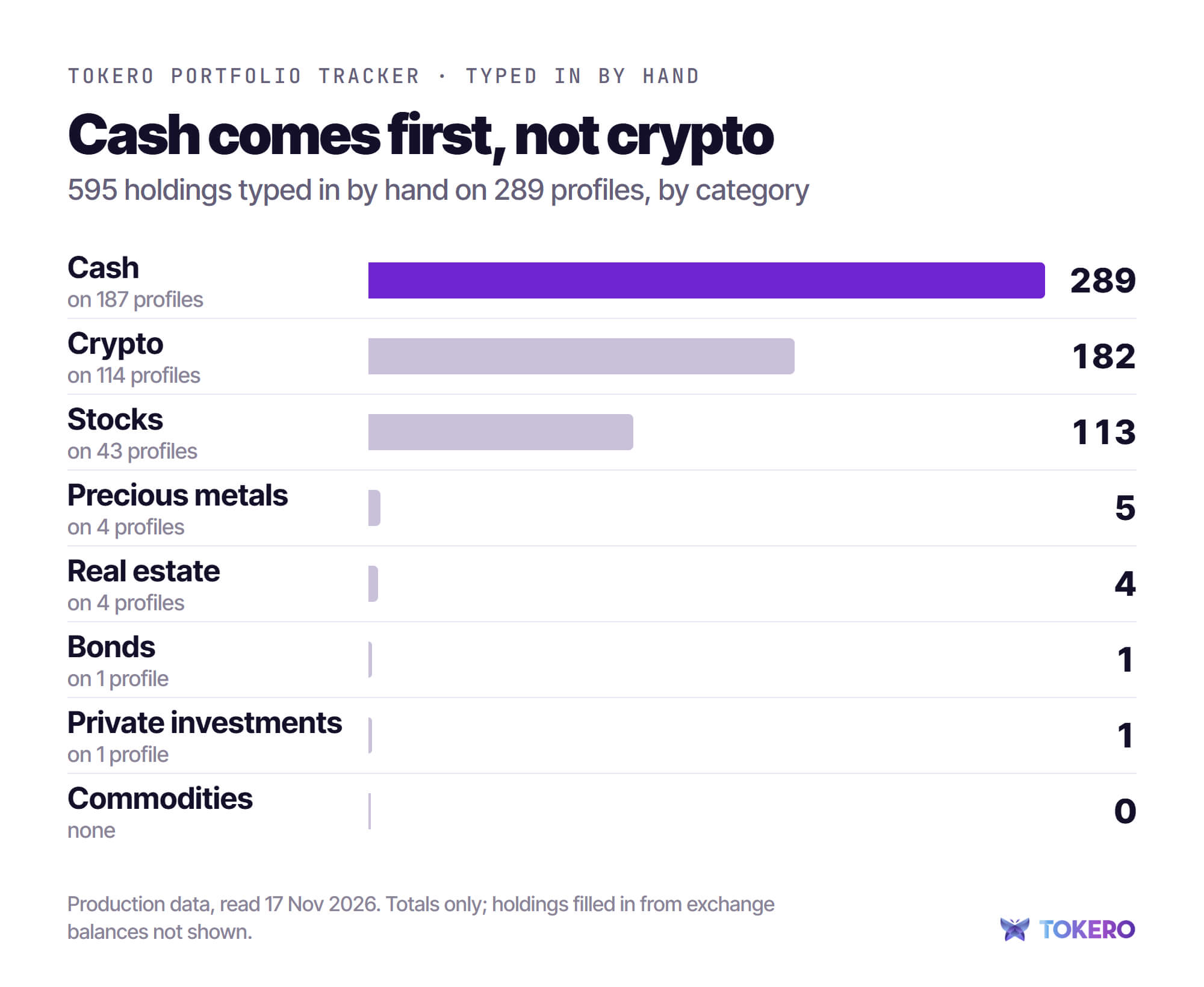
Holdings typed in by hand, by category. None of the 182 crypto rows came from an import.
Cash comes first
I expected crypto to top this list. The tracker sits next to a crypto exchange, and crypto is the one category where typing is optional.
It came second. Cash came first: 289 holdings, nearly half of everything typed by hand, on 187 of the 289 profiles.
Cash is the least exciting thing you can put in a portfolio. It's also what people typed most.
It doesn't move on a chart, and nobody checks it for news. And yet people typed it in, account by account. My reading is that they want the whole picture, including the part that just sits there, because without it every percentage on the screen is a share of the wrong total. Someone with a crypto balance and a savings account wants to know what share of their money is in crypto, and the tracker can only tell them if the savings account is there too.
A third track no crypto at all
The second surprise was who those 289 profiles are.
72 of them track crypto and nothing else. 42 track crypto plus at least one other kind of holding. And 175 typed no crypto at all.
Some of those 175 didn't need to: 49 have their crypto filled in from the exchange, so they typed only the rest. That leaves 126 profiles, more than four in ten of everyone who typed anything, with no crypto anywhere in their portfolio. On a tracker built next to a crypto exchange, they use it for everything else.
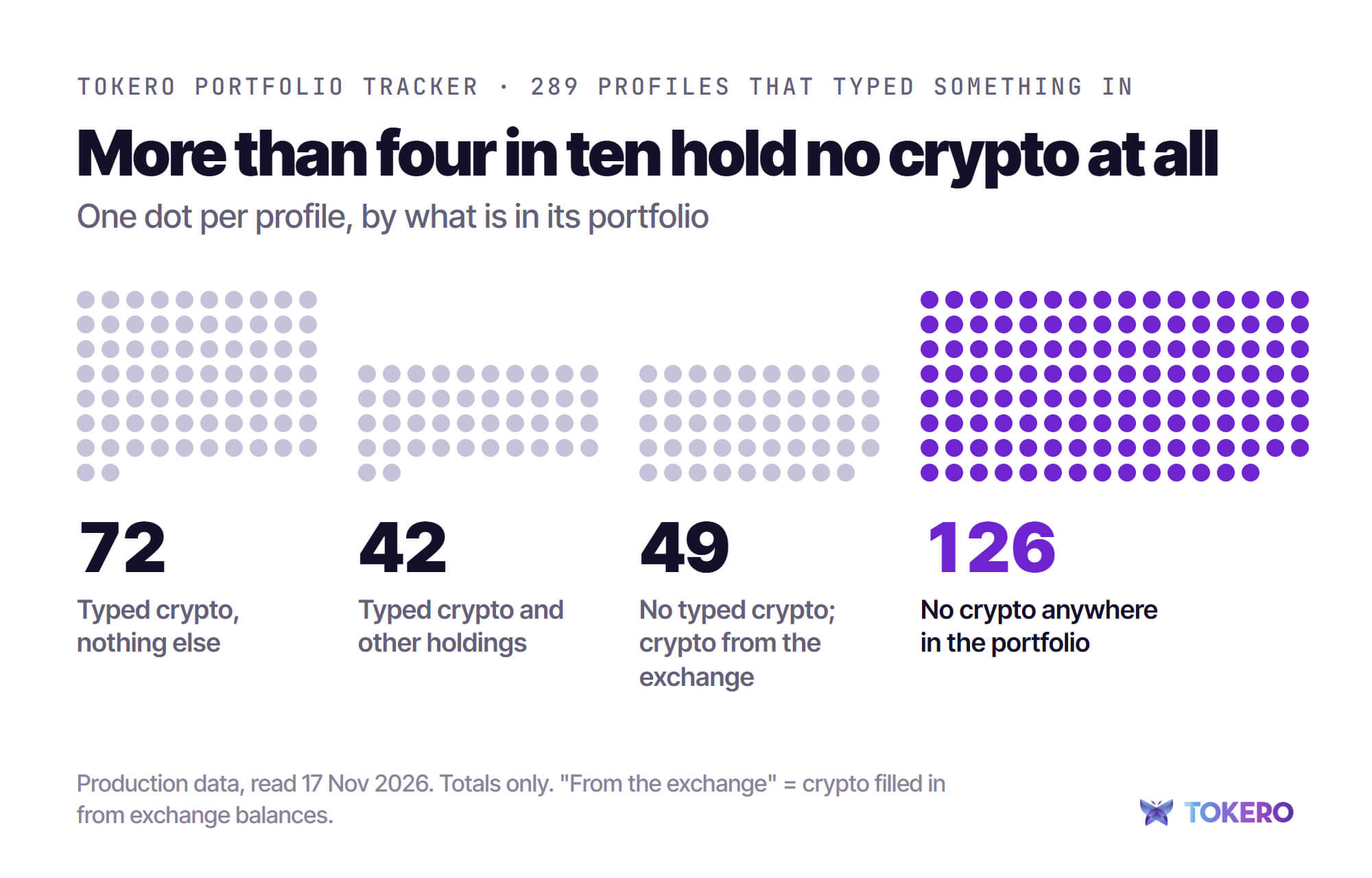
The 289 profiles that typed something in, one dot each.
Only 12 profiles spread across three categories or more. Most people keep it short: one or two kinds of holding, typed in once.
A limit I have to name
Not every category is open to everyone, so this is not a pure picture of what people want to track. On the Explorer tier, the tracker offers crypto, cash and stocks. Real estate comes with the Member tier. Bonds, commodities, precious metals and private investments come with Contributor.
So the near-empty bars at the bottom of the chart say more about access than about interest: few people can add a bond, and one did. What the numbers can say is narrower. Among the three categories everyone can use, cash came first, then crypto, then stocks.
What I take from it
I went in thinking of the tracker as a crypto tool with extra categories. The rows people typed by hand say they use it the other way round, at least the ones who bother to type: as a list of their money, where crypto is one line among several, and for many of them not a line at all.
If you build anything that touches money, that's what I'd look at in your own product: what do people bother to enter by hand, when nothing makes them?
And if you track your own money, try one small exercise: write down everything you hold, including what doesn't move. Then check what share of it is the part you watch every day.
If you want to see how the tracker handles a mixed list, TOKERO's Portfolio is here.
What's on your own list that no app could ever sync?
Octavia Mateescu is a software developer at TOKERO, where she builds the tools creators use to publish and share their work across networks.
Figures: TOKERO production data, portfolio holdings, read on 17 November 2026. Counts of holdings and of profiles per category; deleted holdings are excluded. Holdings typed in by hand include 11 on 6 profiles belonging to the TOKERO team. No individual data was read.
Previously: Yes, people arrive from ChatGPT. Here's how many.
Also published on Medium.