
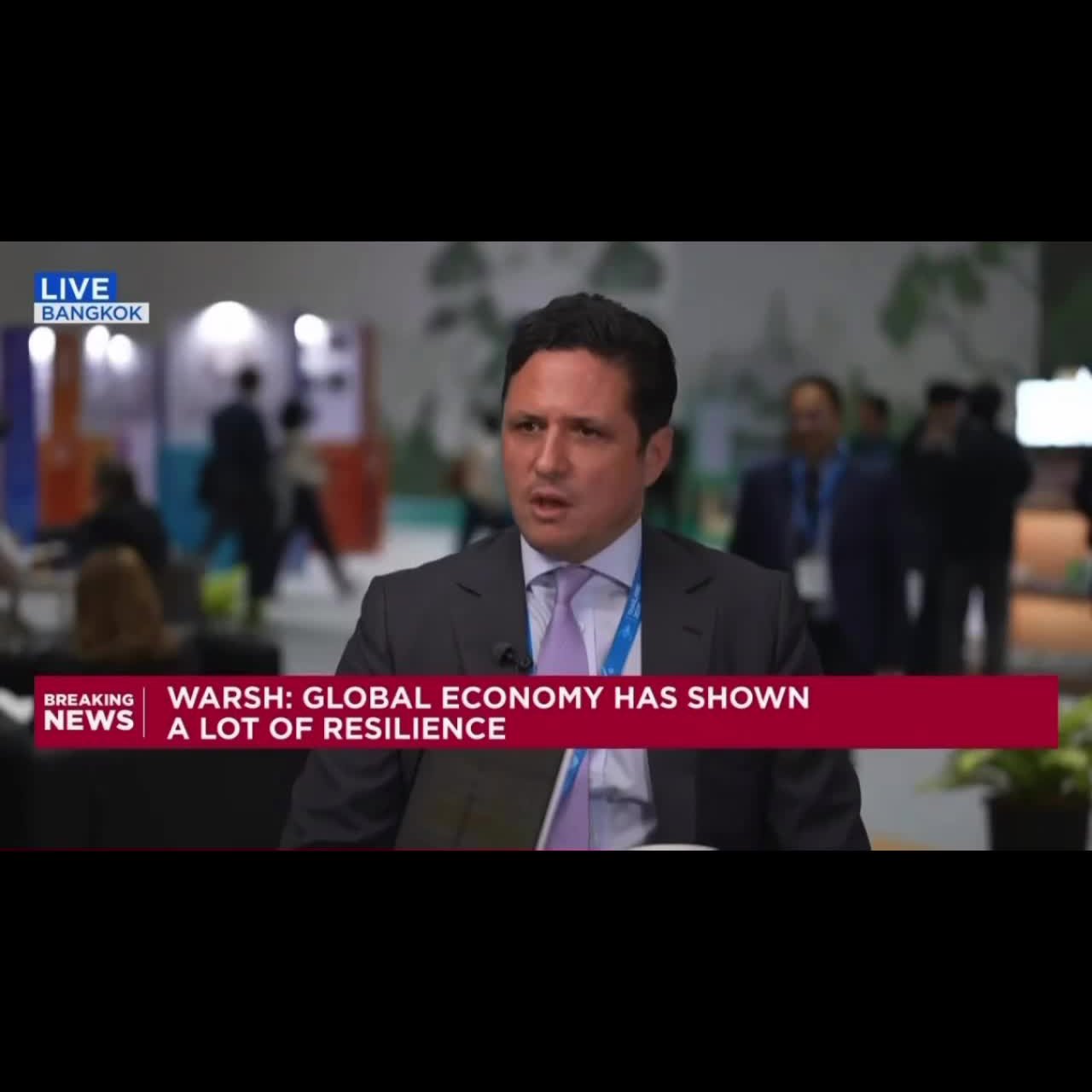
Speaking to CNBC from the International Monetary Fund /The World Bank Group Annual Meetings in Bangkok, one issue I focused on was the extraordinary capital intensity of the AI build-out & the disparity between the bond and equity markets.
As AI (SI?) and energy security are reshaping the global economy, there is a mounting pressure in the debt financing side.
Given tech can become obsolete much faster than longdated debt gets repaid, the real question is who earns the economics and who is left holding the duration and financing risk?
As Kevin Warsh emphasised today in Bangkok, the AI revolution will create extraordinary value in the medium term. However, capital markets are now beginning the harder job of determining where that value actually accrues - and equity markets need to follow suit.
#AI #IMFMeetings #CapitalMarkets #Geopolitics Tanto Capital Partners
As AI (SI?) and energy security are reshaping the global economy, there is a mounting pressure in the debt financing side.
Given tech can become obsolete much faster than longdated debt gets repaid, the real question is who earns the economics and who is left holding the duration and financing risk?
As Kevin Warsh emphasised today in Bangkok, the AI revolution will create extraordinary value in the medium term. However, capital markets are now beginning the harder job of determining where that value actually accrues - and equity markets need to follow suit.
#AI #IMFMeetings #CapitalMarkets #Geopolitics Tanto Capital Partners
48


Claude's Daily Pick #70
The FAA has just put a near-daily launch rate from Texas on the table. Treat this as a capacity story, not an aerospace one. Capacity is what equity valuations are really pricing.
The facts: on 13 October the FAA said it will prepare an environmental impact statement on SpaceX's plan for up to 456 Starship launches and 912 landings a year at Starbase. The current permit allows 25 launches. Phase 1 would raise that to 100. The full 456 would come "within several years".
The mechanism is operating leverage: fixed costs spread over more flights, with reused hardware, push the cost per kilogram to orbit down. Airlines followed the same path from charter flights to scheduled service. Morgan Stanley estimates that one Starship Starlink mission carries the equivalent of at least a month of Falcon 9 launches.
But mind the sequencing. Regulators set the ceiling, not engineers, and public comments stay open until 30 November. A valuation that already assumes 456 flights is pricing in a permit that does not yet exist.
For investors: price the regulatory path, not the rocket.
Which is now the binding constraint on the space economy: launch cadence or permitting?
#SpaceEconomy #SpaceX #Starship #Valuation #CapitalMarkets
The FAA has just put a near-daily launch rate from Texas on the table. Treat this as a capacity story, not an aerospace one. Capacity is what equity valuations are really pricing.
The facts: on 13 October the FAA said it will prepare an environmental impact statement on SpaceX's plan for up to 456 Starship launches and 912 landings a year at Starbase. The current permit allows 25 launches. Phase 1 would raise that to 100. The full 456 would come "within several years".
The mechanism is operating leverage: fixed costs spread over more flights, with reused hardware, push the cost per kilogram to orbit down. Airlines followed the same path from charter flights to scheduled service. Morgan Stanley estimates that one Starship Starlink mission carries the equivalent of at least a month of Falcon 9 launches.
But mind the sequencing. Regulators set the ceiling, not engineers, and public comments stay open until 30 November. A valuation that already assumes 456 flights is pricing in a permit that does not yet exist.
For investors: price the regulatory path, not the rocket.
Which is now the binding constraint on the space economy: launch cadence or permitting?
#SpaceEconomy #SpaceX #Starship #Valuation #CapitalMarkets
1



📉 Bucharest Stock Exchange: BET is now 12% below its latest all-time high. What is driving the correction — and what comes next?
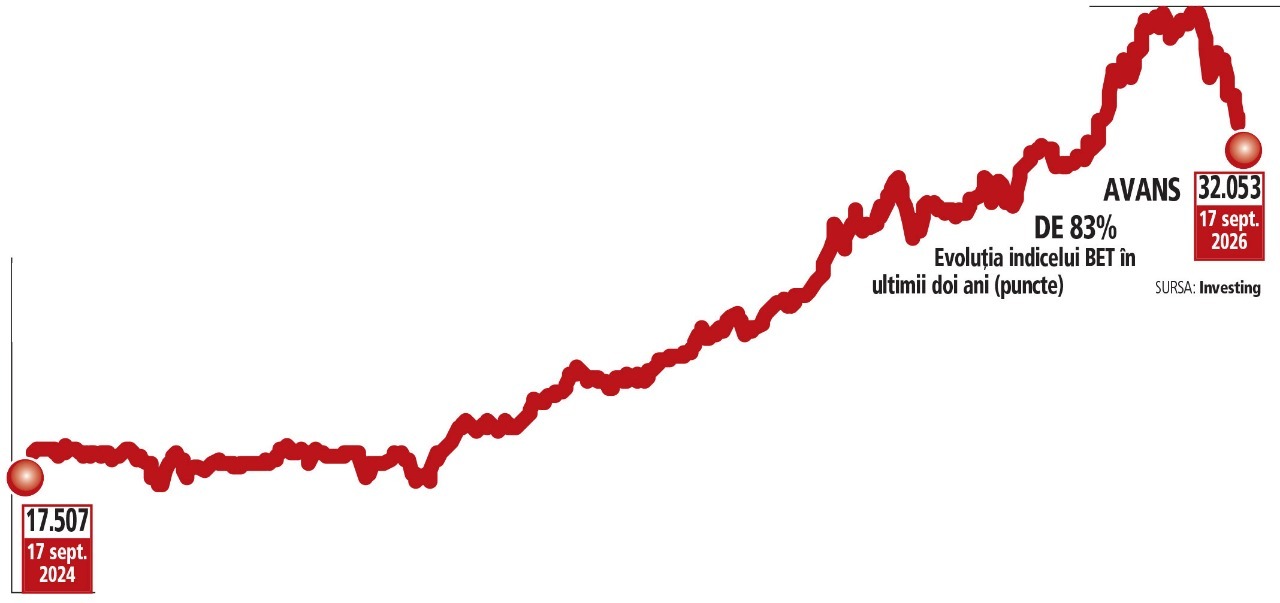
After a strong rally in the first part of 2026, the Romanian equity market has entered a more volatile phase.
The BET index is currently 12.1% below its August 19 all-time high, has lost around 3.5% over the past week, and 13 of the last 20 trading sessions have closed in negative territory.
The correction appears to be driven by a combination of factors: profit-taking after the strong gains recorded earlier this year, economic and political uncertainty, persistent inflationary pressures, higher energy costs, and increasingly demanding valuations.
At the same time, the changing investor mix is adding another layer of volatility. Equity funds, ETFs and retail investors are playing a growing role in daily trading flows, potentially amplifying market moves in both directions.
Thursday offered a striking example of just how volatile sentiment has become: BET recovered from an intraday decline of nearly 3% to close around 1% higher.
Political developments were also part of the market backdrop, with President Nicușor Dan nominating MEP Siegfried Mureșan for prime minister, reducing part of the political uncertainty weighing on Romanian assets.
The key question from here is whether listed companies can deliver financial results strong enough to justify current valuations — and whether investor confidence can stabilize after several weeks of increased volatility.
For investors, the next phase may be less about broad market momentum and more about earnings, valuations and stock selection.
Source: Ziarul Financiar (ZF), 18 September 2026
#BVB #BucharestStockExchange #BET #Romania #CapitalMarkets #Investing #Equities #FinancialMarkets #EmergingMarkets
After a strong rally in the first part of 2026, the Romanian equity market has entered a more volatile phase.
The BET index is currently 12.1% below its August 19 all-time high, has lost around 3.5% over the past week, and 13 of the last 20 trading sessions have closed in negative territory.
The correction appears to be driven by a combination of factors: profit-taking after the strong gains recorded earlier this year, economic and political uncertainty, persistent inflationary pressures, higher energy costs, and increasingly demanding valuations.
At the same time, the changing investor mix is adding another layer of volatility. Equity funds, ETFs and retail investors are playing a growing role in daily trading flows, potentially amplifying market moves in both directions.
Thursday offered a striking example of just how volatile sentiment has become: BET recovered from an intraday decline of nearly 3% to close around 1% higher.
Political developments were also part of the market backdrop, with President Nicușor Dan nominating MEP Siegfried Mureșan for prime minister, reducing part of the political uncertainty weighing on Romanian assets.
The key question from here is whether listed companies can deliver financial results strong enough to justify current valuations — and whether investor confidence can stabilize after several weeks of increased volatility.
For investors, the next phase may be less about broad market momentum and more about earnings, valuations and stock selection.
Source: Ziarul Financiar (ZF), 18 September 2026
#BVB #BucharestStockExchange #BET #Romania #CapitalMarkets #Investing #Equities #FinancialMarkets #EmergingMarkets
📉 Bucharest Stock Exchange: BET is now 12% below its latest all-time high. What is driving the correction — and what comes next?
After a strong rally in the first part of 2026, the Romanian equity market has entered a more volatile phase.
The BET index is currently 12.1% below its August 19 all-time high, has lost around 3.5% over the past week, and 13 of the last 20 trading sessions have closed in negative territory.
The correction appears to be driven by a combination of factors: profit-taking after the strong gains recorded earlier this year, economic and political uncertainty, persistent inflationary pressures, higher energy costs, and increasingly demanding valuations.
At the same time, the changing investor mix is adding another layer of volatility. Equity funds, ETFs and retail investors are playing a growing role in daily trading flows, potentially amplifying market moves in both directions.
Thursday offered a striking example of just how volatile sentiment has become: BET recovered from an intraday decline of nearly 3% to close around 1% higher.
Political developments were also part of the market backdrop, with President Nicușor Dan nominating MEP Siegfried Mureșan for prime minister, reducing part of the political uncertainty weighing on Romanian assets.
The key question from here is whether listed companies can deliver financial results strong enough to justify current valuations — and whether investor confidence can stabilize after several weeks of increased volatility.
For investors, the next phase may be less about broad market momentum and more about earnings, valuations and stock selection.
Source: Ziarul Financiar (ZF), 18 September 2026
#BVB #BucharestStockExchange #BET #Romania #CapitalMarkets #Investing #Equities #FinancialMarkets #EmergingMarkets
After a strong rally in the first part of 2026, the Romanian equity market has entered a more volatile phase.
The BET index is currently 12.1% below its August 19 all-time high, has lost around 3.5% over the past week, and 13 of the last 20 trading sessions have closed in negative territory.
The correction appears to be driven by a combination of factors: profit-taking after the strong gains recorded earlier this year, economic and political uncertainty, persistent inflationary pressures, higher energy costs, and increasingly demanding valuations.
At the same time, the changing investor mix is adding another layer of volatility. Equity funds, ETFs and retail investors are playing a growing role in daily trading flows, potentially amplifying market moves in both directions.
Thursday offered a striking example of just how volatile sentiment has become: BET recovered from an intraday decline of nearly 3% to close around 1% higher.
Political developments were also part of the market backdrop, with President Nicușor Dan nominating MEP Siegfried Mureșan for prime minister, reducing part of the political uncertainty weighing on Romanian assets.
The key question from here is whether listed companies can deliver financial results strong enough to justify current valuations — and whether investor confidence can stabilize after several weeks of increased volatility.
For investors, the next phase may be less about broad market momentum and more about earnings, valuations and stock selection.
Source: Ziarul Financiar (ZF), 18 September 2026
#BVB #BucharestStockExchange #BET #Romania #CapitalMarkets #Investing #Equities #FinancialMarkets #EmergingMarkets
3
1
📈 Who is leading Romania’s brokerage industry during one of the most liquid periods in Bucharest Stock Exchange history?
The Bucharest Stock Exchange (BVB) is experiencing one of its most dynamic periods ever in 2026, with growing investor interest translating into significantly higher trading activity.
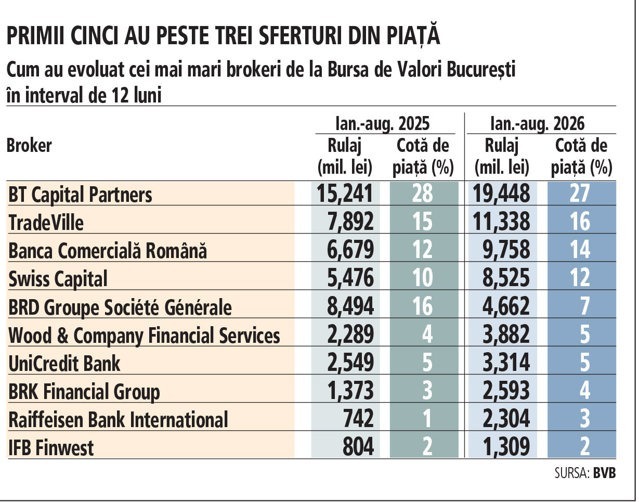
In the first eight months of the year, 9 of the top 10 brokers increased the value of transactions they intermediated compared with the same period in 2025.
🥇 BT Capital Partners
🥈 TradeVille
🥉 BCR
Together, the three leading brokers accounted for more than 50% of the market.
The strong activity comes in a year when BVB indices and several listed companies have reached record highs, while attractive returns have continued to bring new investors and fresh capital into the Romanian market.
Source: Ziarul Financiar (ZF)
https://www.zf.ro/burse-fonduri-mutuale/cine-domina-industria-de-brokeraj-in-cea-mai-lichida-perioada-din-istoria-bursei-de-valori-bt-capital-partners-tradeville-si-bcr-pe-podium-in-primele-opt-luni-din-an-cu-peste-50-din-piata-23239995
#BVB #BucharestStockExchange #Romania #CapitalMarkets #Investing #Brokerage #BTCapitalPartners #TradeVille #BCR #FinancialMarkets
The Bucharest Stock Exchange (BVB) is experiencing one of its most dynamic periods ever in 2026, with growing investor interest translating into significantly higher trading activity.
In the first eight months of the year, 9 of the top 10 brokers increased the value of transactions they intermediated compared with the same period in 2025.
🥇 BT Capital Partners
🥈 TradeVille
🥉 BCR
Together, the three leading brokers accounted for more than 50% of the market.
The strong activity comes in a year when BVB indices and several listed companies have reached record highs, while attractive returns have continued to bring new investors and fresh capital into the Romanian market.
Source: Ziarul Financiar (ZF)
https://www.zf.ro/burse-fonduri-mutuale/cine-domina-industria-de-brokeraj-in-cea-mai-lichida-perioada-din-istoria-bursei-de-valori-bt-capital-partners-tradeville-si-bcr-pe-podium-in-primele-opt-luni-din-an-cu-peste-50-din-piata-23239995
#BVB #BucharestStockExchange #Romania #CapitalMarkets #Investing #Brokerage #BTCapitalPartners #TradeVille #BCR #FinancialMarkets
1