
When negotiating a pay rise you need to know how much of a £1,000 pay rise do you actually keep?
The answer depends on what you already earn.
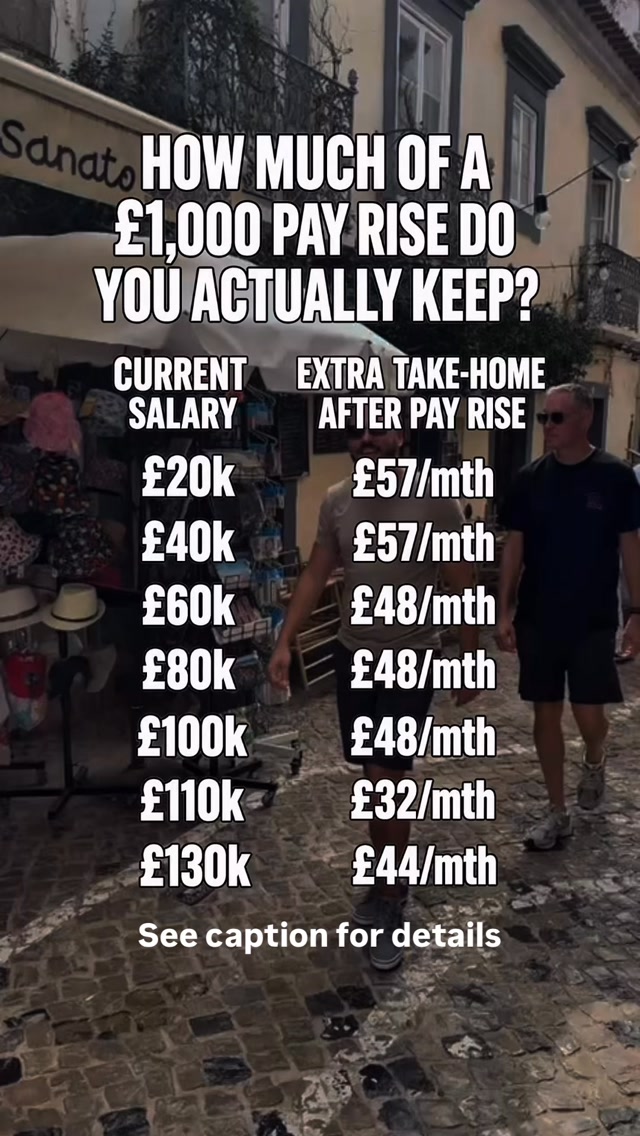
This table shows the extra monthly take-home pay from a £1,000 increase in annual gross salary.
At £20k or £40k, you keep around £57 a month.
At £60k, £80k and £100k, it’s around £48 a month.
At £110k, it falls to roughly £32 a month because of the Personal Allowance taper, which can create an effective 60% income-tax rate on part of your income.
By £130k, it rises again to around £44 a month because the Personal Allowance has already been lost and the marginal income-tax rate is 45%, plus employee National Insurance.
The figures assume:
* you’re employed and paid through PAYE
* you live in England, Wales or Northern Ireland
* standard tax code
* standard employee National Insurance
* minimum auto-enrolment pension contributions using relief at source
* no student loan, salary sacrifice or other deductions
Under relief at source, the minimum employee-side auto-enrolment contribution is typically 5% of qualifying earnings, but only 4% comes from your take-home pay, with basic-rate tax relief making up the other 1%. Employer minimum contributions are generally 3%. Qualifying earnings for 2026/27 run from £6,240 to £50,270.
So the point is simple:
A £1,000 pay rise doesn’t mean £1,000 more in your pocket. And the amount you keep can vary dramatically depending on where you sit in the tax system.
As a general rule of thumb, multiply the figures by five for a £5,000 pay rise, or by ten for a £10,000 rise. However, this won’t be exact if your pay rise crosses key tax thresholds.
#personalfinance #costofliving #ukmoney #personalfinanceuk #moneytips
7
The most expensive thing in your house to run is almost certainly your tumble dryer 😬
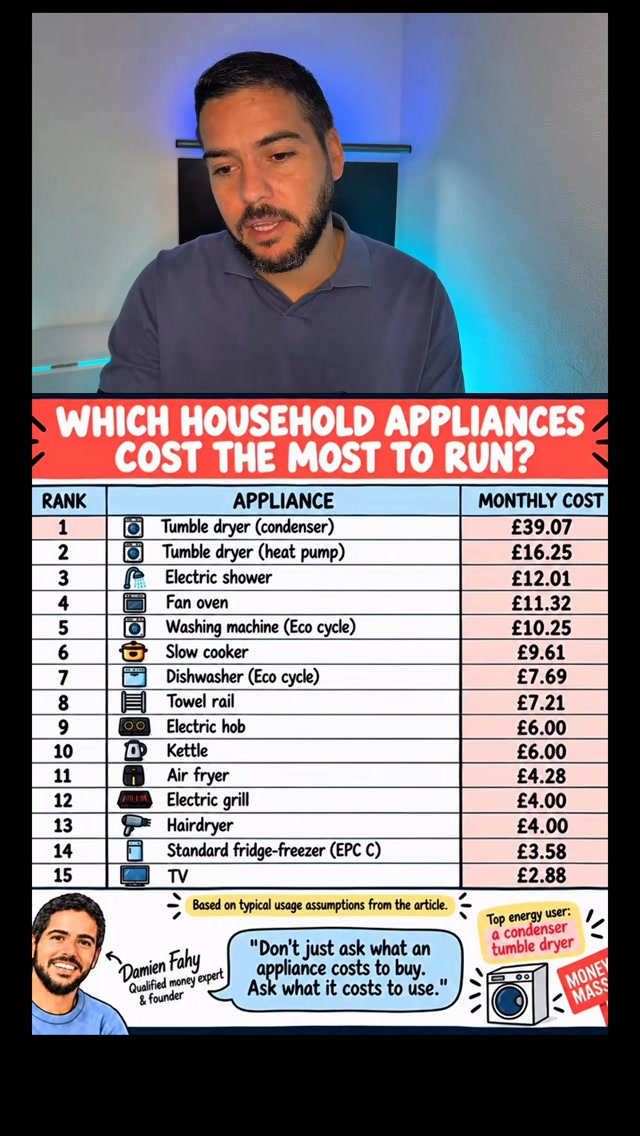
Here is what each appliance costs per month, if you use it every day:
👕 Tumble dryer, condenser, one full load a day: £39.07
♻️ Tumble dryer, heat pump, one full load a day: £16.25
🚿 Electric shower, 10 mins a day: £12.01
🔥 Fan oven, 1 hour a day: £11.32
🧺 Washing machine, eco, one full load a day: £10.25
🍲 Slow cooker, 6 hours a day: £9.61
🍽️ Dishwasher, eco, one cycle a day: £7.69
🛁 Towel rail, 2 hours a day: £7.21
🍳 Electric hob, 30 mins a day: £6.00
☕ Kettle, 15 mins a day: £6.00
🍟 Air fryer, 30 mins a day: £4.28
🥩 Electric grill, 20 mins a day: £4.00
💇 Hairdryer, 15 mins a day: £4.00
🧊 Fridge freezer (EPC C), on 24 hours: £3.58
📺 TV, 3 hours a day: £2.88
Two things stand out. A heat pump tumble dryer does the same job for less than half the cost of a condenser one. And the air fryer costs about a third of the fan oven to run, which settles that argument.
The assumptions, so you can judge for yourself:
📌 Electricity at 26.32p per kWh, the Ofgem price cap from 1 October 2026
📌 Standing charges are not included, since you pay those whatever you use
📌 Each appliance is costed on daily use, for example 10 minutes in the shower, an hour with the oven on, 6 hours in the slow cooker, 30 minutes for the hob and the air fryer, 15 minutes for the kettle, and one full cycle a day for the washing machine, dishwasher and tumble dryer
📌 Based on average wattage, so your own appliance could be more or less efficient
Use less than that and your cost drops in proportion. Use more and it climbs.
The bigger point: when you buy an appliance, the price on the label is only half the cost. A cheap tumble dryer that costs £39 a month to run is not cheap. Check the energy rating before you buy, because once you own it, it could cost you a small fortune.
Full table for every appliance in the home is on Money to the Masses, link in bio 🔗
Which one surprised you? 👇
#energybills #costofliving #ukmoney #personalfinanceuk #moneytips
1.2K



Europe is facing a fresh economic challenge as energy shocks push inflation higher and slow down growth across the region.
Romania stands out the most:
• Inflation has surged close to 10% (≈9.9% in March)
• The highest inflation rate in the entire EU (~9%)
• Rising fuel costs linked to global tensions are driving prices up
📊 What this means:
• Cost of living pressure remains high in Romania
• Interest rate cuts may be delayed
• Economic growth in Europe is expected to stay weak (~1% range)
Bottom line: Romania is currently one of the most inflation-affected economies in the EU—making personal finance decisions more important than ever.
#Romania #EUeconomy #Inflation #FinanceNews #CostOfLiving

3
Ai ajuns la finalul listei 🎉