


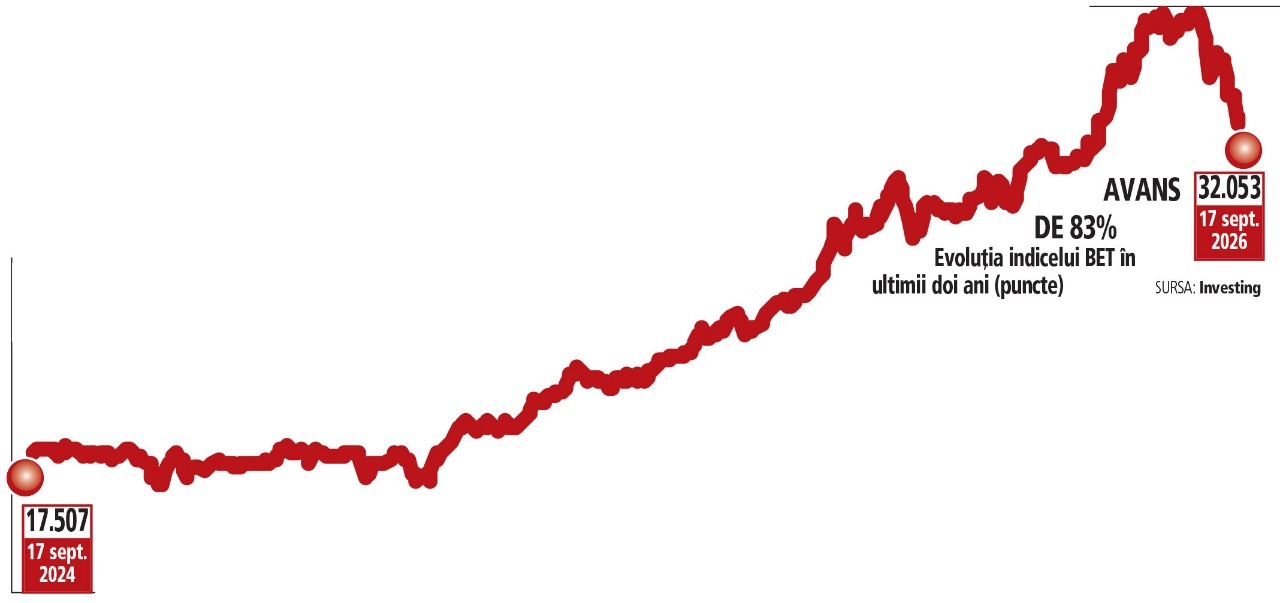
📉 Bucharest Stock Exchange: BET is now 12% below its latest all-time high. What is driving the correction — and what comes next?
After a strong rally in the first part of 2026, the Romanian equity market has entered a more volatile phase.
The BET index is currently 12.1% below its August 19 all-time high, has lost around 3.5% over the past week, and 13 of the last 20 trading sessions have closed in negative territory.
The correction appears to be driven by a combination of factors: profit-taking after the strong gains recorded earlier this year, economic and political uncertainty, persistent inflationary pressures, higher energy costs, and increasingly demanding valuations.
At the same time, the changing investor mix is adding another layer of volatility. Equity funds, ETFs and retail investors are playing a growing role in daily trading flows, potentially amplifying market moves in both directions.
Thursday offered a striking example of just how volatile sentiment has become: BET recovered from an intraday decline of nearly 3% to close around 1% higher.
Political developments were also part of the market backdrop, with President Nicușor Dan nominating MEP Siegfried Mureșan for prime minister, reducing part of the political uncertainty weighing on Romanian assets.
The key question from here is whether listed companies can deliver financial results strong enough to justify current valuations — and whether investor confidence can stabilize after several weeks of increased volatility.
For investors, the next phase may be less about broad market momentum and more about earnings, valuations and stock selection.
Source: Ziarul Financiar (ZF), 18 September 2026
#BVB #BucharestStockExchange #BET #Romania #CapitalMarkets #Investing #Equities #FinancialMarkets #EmergingMarkets
📉 Bucharest Stock Exchange: BET is now 12% below its latest all-time high. What is driving the correction — and what comes next?
After a strong rally in the first part of 2026, the Romanian equity market has entered a more volatile phase.
The BET index is currently 12.1% below its August 19 all-time high, has lost around 3.5% over the past week, and 13 of the last 20 trading sessions have closed in negative territory.
The correction appears to be driven by a combination of factors: profit-taking after the strong gains recorded earlier this year, economic and political uncertainty, persistent inflationary pressures, higher energy costs, and increasingly demanding valuations.
At the same time, the changing investor mix is adding another layer of volatility. Equity funds, ETFs and retail investors are playing a growing role in daily trading flows, potentially amplifying market moves in both directions.
Thursday offered a striking example of just how volatile sentiment has become: BET recovered from an intraday decline of nearly 3% to close around 1% higher.
Political developments were also part of the market backdrop, with President Nicușor Dan nominating MEP Siegfried Mureșan for prime minister, reducing part of the political uncertainty weighing on Romanian assets.
The key question from here is whether listed companies can deliver financial results strong enough to justify current valuations — and whether investor confidence can stabilize after several weeks of increased volatility.
For investors, the next phase may be less about broad market momentum and more about earnings, valuations and stock selection.
Source: Ziarul Financiar (ZF), 18 September 2026
#BVB #BucharestStockExchange #BET #Romania #CapitalMarkets #Investing #Equities #FinancialMarkets #EmergingMarkets
After a strong rally in the first part of 2026, the Romanian equity market has entered a more volatile phase.
The BET index is currently 12.1% below its August 19 all-time high, has lost around 3.5% over the past week, and 13 of the last 20 trading sessions have closed in negative territory.
The correction appears to be driven by a combination of factors: profit-taking after the strong gains recorded earlier this year, economic and political uncertainty, persistent inflationary pressures, higher energy costs, and increasingly demanding valuations.
At the same time, the changing investor mix is adding another layer of volatility. Equity funds, ETFs and retail investors are playing a growing role in daily trading flows, potentially amplifying market moves in both directions.
Thursday offered a striking example of just how volatile sentiment has become: BET recovered from an intraday decline of nearly 3% to close around 1% higher.
Political developments were also part of the market backdrop, with President Nicușor Dan nominating MEP Siegfried Mureșan for prime minister, reducing part of the political uncertainty weighing on Romanian assets.
The key question from here is whether listed companies can deliver financial results strong enough to justify current valuations — and whether investor confidence can stabilize after several weeks of increased volatility.
For investors, the next phase may be less about broad market momentum and more about earnings, valuations and stock selection.
Source: Ziarul Financiar (ZF), 18 September 2026
#BVB #BucharestStockExchange #BET #Romania #CapitalMarkets #Investing #Equities #FinancialMarkets #EmergingMarkets
3
1

🇷🇴 **Romania’s financial outlook is improving—but remains fragile.**
Fitch has reaffirmed Romania’s **BBB- investment-grade rating**, while maintaining a negative outlook. The agency expects the budget deficit to decline to approximately **5.9% of GDP in 2026**, reflecting stronger-than-anticipated fiscal consolidation.
The latest budget figures support that assessment: Romania’s deficit fell to **2% of GDP in the first half of 2026**, compared with 3.64% during the same period last year. The Ministry of Finance attributes the improvement to tighter control of current spending, stronger revenue collection and increased absorption of European funds.
At the same time, the National Bank of Romania has kept its monetary-policy rate at **6.5%**, signaling that inflationary pressures and economic uncertainty still require a cautious approach.
New risks are also emerging. Record-low Danube levels have disrupted energy production and industrial activity, potentially increasing electricity costs and adding further pressure to inflation and economic growth.
**The takeaway:** Romania has gained valuable fiscal breathing room, but not a clean bill of health. Maintaining political stability, controlling expenditure and protecting investment will determine whether this progress becomes a sustainable economic recovery.
#Romania #Finance #Economy #FiscalPolicy #Banking #EmergingMarkets #Investment
2

📈 Romania is proving that long-term investing pays off.
Over the last decade, Romania's equity market has emerged as the world's best-performing stock market, outperforming many of the world's largest and most established markets. Strong total returns, attractive valuations, and consistent dividend yields continue to put the Bucharest Stock Exchange on investors' radar.
A reminder that great opportunities can often be found where few are looking.
#Romania #Investing #StockMarket #BucharestStockExchange #CapitalMarkets #EmergingMarkets #Finance
Tu as atteint la fin 🎉