
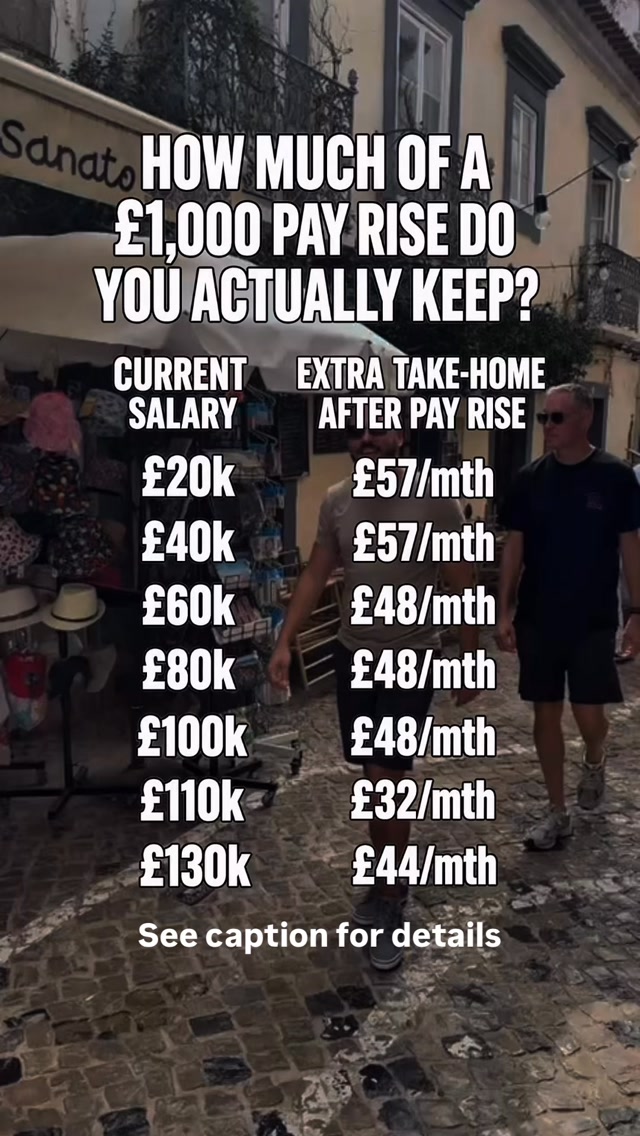
When negotiating a pay rise you need to know how much of a £1,000 pay rise do you actually keep?
The answer depends on what you already earn.
This table shows the extra monthly take-home pay from a £1,000 increase in annual gross salary.
At £20k or £40k, you keep around £57 a month.
At £60k, £80k and £100k, it’s around £48 a month.
At £110k, it falls to roughly £32 a month because of the Personal Allowance taper, which can create an effective 60% income-tax rate on part of your income.
By £130k, it rises again to around £44 a month because the Personal Allowance has already been lost and the marginal income-tax rate is 45%, plus employee National Insurance.
The figures assume:
* you’re employed and paid through PAYE
* you live in England, Wales or Northern Ireland
* standard tax code
* standard employee National Insurance
* minimum auto-enrolment pension contributions using relief at source
* no student loan, salary sacrifice or other deductions
Under relief at source, the minimum employee-side auto-enrolment contribution is typically 5% of qualifying earnings, but only 4% comes from your take-home pay, with basic-rate tax relief making up the other 1%. Employer minimum contributions are generally 3%. Qualifying earnings for 2026/27 run from £6,240 to £50,270.
So the point is simple:
A £1,000 pay rise doesn’t mean £1,000 more in your pocket. And the amount you keep can vary dramatically depending on where you sit in the tax system.
As a general rule of thumb, multiply the figures by five for a £5,000 pay rise, or by ten for a £10,000 rise. However, this won’t be exact if your pay rise crosses key tax thresholds.
#personalfinance #costofliving #ukmoney #personalfinanceuk #moneytips
7
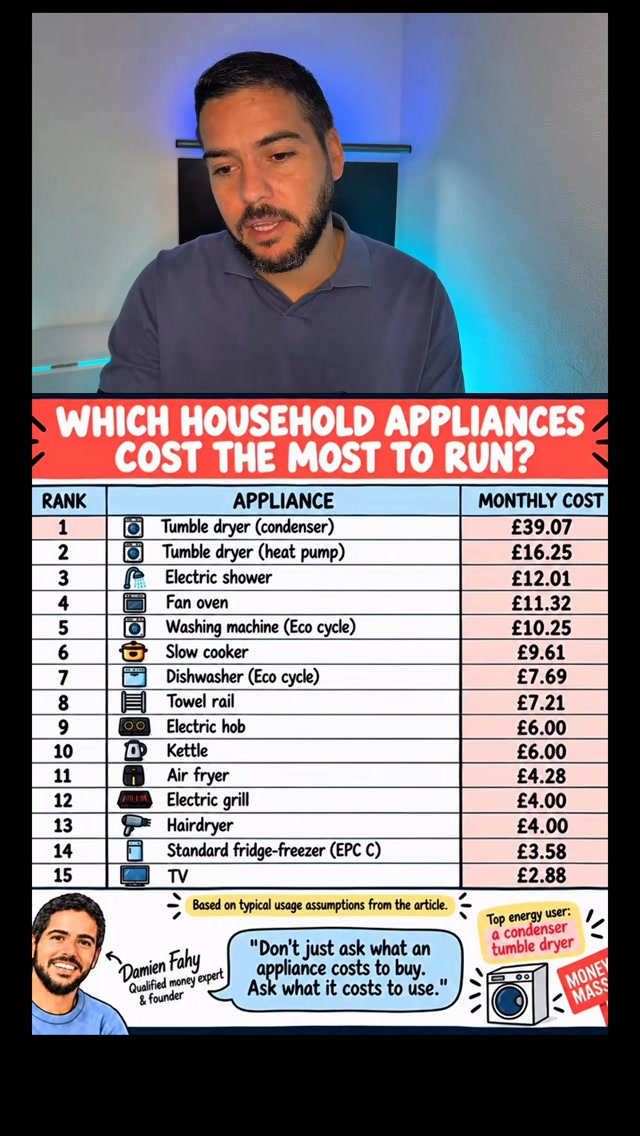
The most expensive thing in your house to run is almost certainly your tumble dryer 😬
Here is what each appliance costs per month, if you use it every day:
👕 Tumble dryer, condenser, one full load a day: £39.07
♻️ Tumble dryer, heat pump, one full load a day: £16.25
🚿 Electric shower, 10 mins a day: £12.01
🔥 Fan oven, 1 hour a day: £11.32
🧺 Washing machine, eco, one full load a day: £10.25
🍲 Slow cooker, 6 hours a day: £9.61
🍽️ Dishwasher, eco, one cycle a day: £7.69
🛁 Towel rail, 2 hours a day: £7.21
🍳 Electric hob, 30 mins a day: £6.00
☕ Kettle, 15 mins a day: £6.00
🍟 Air fryer, 30 mins a day: £4.28
🥩 Electric grill, 20 mins a day: £4.00
💇 Hairdryer, 15 mins a day: £4.00
🧊 Fridge freezer (EPC C), on 24 hours: £3.58
📺 TV, 3 hours a day: £2.88
Two things stand out. A heat pump tumble dryer does the same job for less than half the cost of a condenser one. And the air fryer costs about a third of the fan oven to run, which settles that argument.
The assumptions, so you can judge for yourself:
📌 Electricity at 26.32p per kWh, the Ofgem price cap from 1 October 2026
📌 Standing charges are not included, since you pay those whatever you use
📌 Each appliance is costed on daily use, for example 10 minutes in the shower, an hour with the oven on, 6 hours in the slow cooker, 30 minutes for the hob and the air fryer, 15 minutes for the kettle, and one full cycle a day for the washing machine, dishwasher and tumble dryer
📌 Based on average wattage, so your own appliance could be more or less efficient
Use less than that and your cost drops in proportion. Use more and it climbs.
The bigger point: when you buy an appliance, the price on the label is only half the cost. A cheap tumble dryer that costs £39 a month to run is not cheap. Check the energy rating before you buy, because once you own it, it could cost you a small fortune.
Full table for every appliance in the home is on Money to the Masses, link in bio 🔗
Which one surprised you? 👇
#energybills #costofliving #ukmoney #personalfinanceuk #moneytips
1.2K

Ad | How I split my £175k portfolio as a 31-year-old trader 👉
Most people expect a trader’s portfolio to be full of risky bets. But mine is mostly boring…
I hold it across 3 platforms @trading212 @xtb_uk @investengine to stay within FSCS protection limits, which made it a nightmare to see my overall split… until I started tracking everything in one place with @meetblossomsocial !
My full portfolio is now public there, you can follow to see every ETF and every stock I hold.
💌 Comment ‘BLOSSOM’ and I’ll send you the link (free to download!)
Save this for when you’re building your own core and satellite split
⚠️This is not a recommendation. Never blindly copy anyone: your risk appetite and time horizon aren’t the same as mine. Past performance isn’t a guide to future returns. When you invest, capital is at risk.
#investinguk #portfoliobreakdown #blossomcreator #personalfinanceuk

120
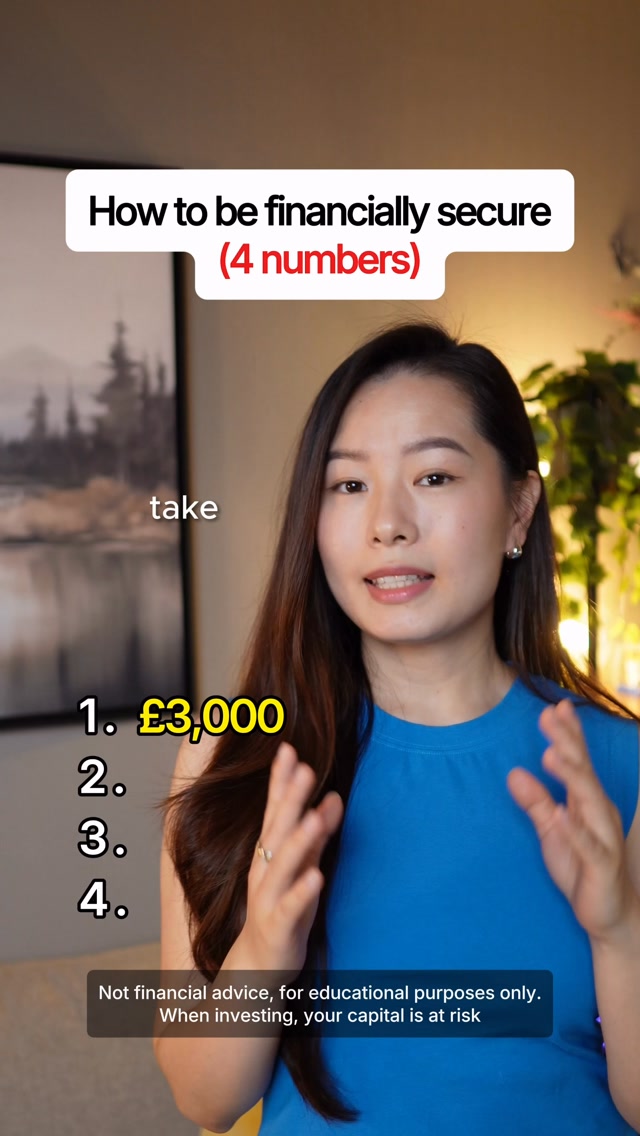
Most people measure financial security by their salary. Wrong number. 🙅♀️
Security comes down to four:
1️⃣ Your emergency fund: 3 to 6 months of essential spending in easy-access cash. Your “life happens” money.
2️⃣ Your yearly investing number: the total you put to work each year across your pension and ISA. This decides how fast you get to number 4.
3️⃣ Your pension contribution: the % of your salary going in each month. At minimum, enough to get your full employer match. Skipping that is turning down free money.
4️⃣ Your FIRE number: roughly 25x your yearly spending (a rule of thumb, not a guarantee). The pot where work becomes optional.
You don’t need to hit all four tomorrow. You need to know them.
Save this and work out yours, and follow @michelle.huangyy for more financial education
⚠️ For educational purposes only, not financial advice. I’m not a regulated financial adviser, so do your own research or speak to one before making decisions. Capital at risk: investments can go down as well as up and you may get back less than you put in. Tax treatment depends on your individual circumstances and can change. Pension money usually can’t be accessed until age 55 (rising to 57 from 2028).
#personalfinanceuk #fire #emergencyfund #ukinvesting moneytips
149
Your asset allocation isn’t set-and-forget. It evolves with your life 👇
Asset allocation is how your money is divided between different types of investments, mainly growth assets like equities and more stable assets like bonds.
The fundamentals:
📈 Equities have historically offered higher potential growth, but with bigger swings along the way
🛡️ Bonds have historically been less volatile, but with lower potential returns
⏳ Your time horizon is key. The longer until you need the money, the more time you have to ride out downturns
🧠 Risk capacity (what you can afford to lose) and risk tolerance (what you can stomach) are not the same thing
Why it changes with age:
Earlier in life, you have more time to recover from falls in the market. As you get closer to needing the money, a big drop matters more, so many people gradually shift towards lower-risk assets. This is often called a “glide path”.
There’s no universal split. It depends on your goals, timeline, circumstances and how you’d react to a 30% fall.
Save this and send it to someone who’s never thought about their allocation, follow @michelle.huangyy for more financial education.
⚠️This is general education, not personal advice or a recommendation. Capital at risk. The value of investments can go down as well as up, and you may get back less than you invest. Past performance isn’t a guide to future returns.
#investingmadesimple #assetallocation #etfinvesting #personalfinanceuk #investingforbeginners

130