
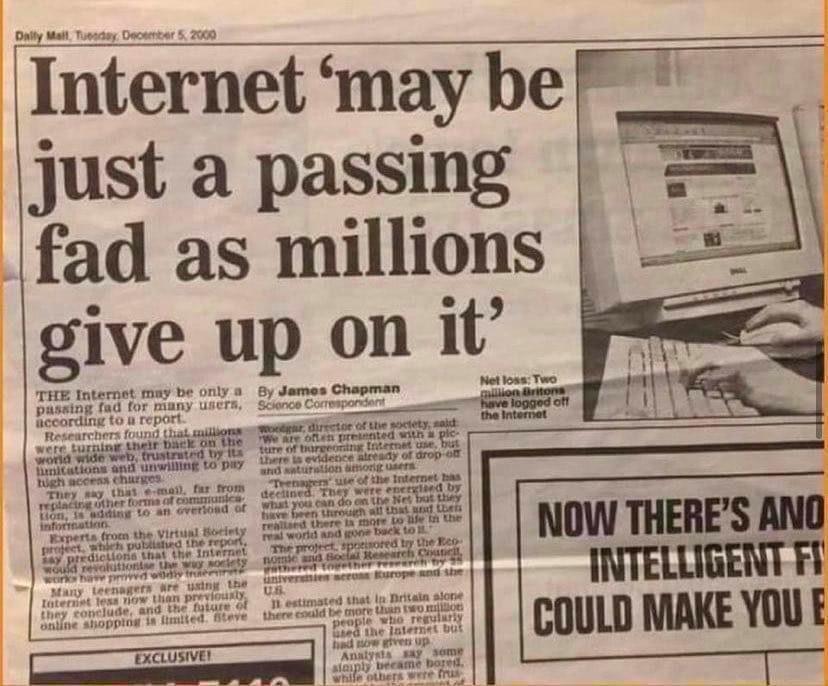
In the early 2000s, one big promise of the internet was that geography would matter less.
A developer in Romania, India or the US could theoretically compete for the same work. Many expected this to help close the economic gap between countries.
The first part happened. The second didn't.
Today ~94% of people in high-income countries are online, compared with ~23% in low-income countries. The internet became global. Prosperity didn't.
Turns out access to information wasn't the great equalizer we imagined. Infrastructure, education, capital and institutions still matter — a lot.
Worth remembering when we make the same promises about AI today.
sources: OECD (2002), ITU (2025)
https://www.oecd.org/en/publications/electronic-commerce-for-development_9789264099562-en.html
https://www.itu.int/itu-d/reports/statistics/2025/10/15/ff25-internet-use/
https://www.oecd.org/en/publications/electronic-commerce-for-development_9789264099562-en.html
https://www.itu.int/itu-d/reports/statistics/2025/10/15/ff25-internet-use/
A developer in Romania, India or the US could theoretically compete for the same work. Many expected this to help close the economic gap between countries.
The first part happened. The second didn't.
Today ~94% of people in high-income countries are online, compared with ~23% in low-income countries. The internet became global. Prosperity didn't.
Turns out access to information wasn't the great equalizer we imagined. Infrastructure, education, capital and institutions still matter — a lot.
Worth remembering when we make the same promises about AI today.
sources: OECD (2002), ITU (2025)
https://www.oecd.org/en/publications/electronic-commerce-for-development_9789264099562-en.html
https://www.itu.int/itu-d/reports/statistics/2025/10/15/ff25-internet-use/
https://www.oecd.org/en/publications/electronic-commerce-for-development_9789264099562-en.html
https://www.itu.int/itu-d/reports/statistics/2025/10/15/ff25-internet-use/
1