49 speakers, 20 minutes each, four days
Pubblicato da Elena-Octavia Mateescu, 2026-11-20

On 25 March we ran our first online summit in a single day. Thirty talks from 28 speakers, back to back, from morning to evening: ten hours of programme in one sitting.
Seven months later, from 21 to 24 October, we ran the second one. It had more speakers, nearly twice as many, and it didn't get a longer day. It got more days.
I'm a developer at TOKERO, a social network about money, and I work on the pages a summit runs on: the schedule, the live page, the chat next to the stream. So I know the shape of both events from the inside, slot by slot. This is what the second one looked like in numbers.
The shape
49 speakers. 49 talks. Every one of them exactly 20 minutes.
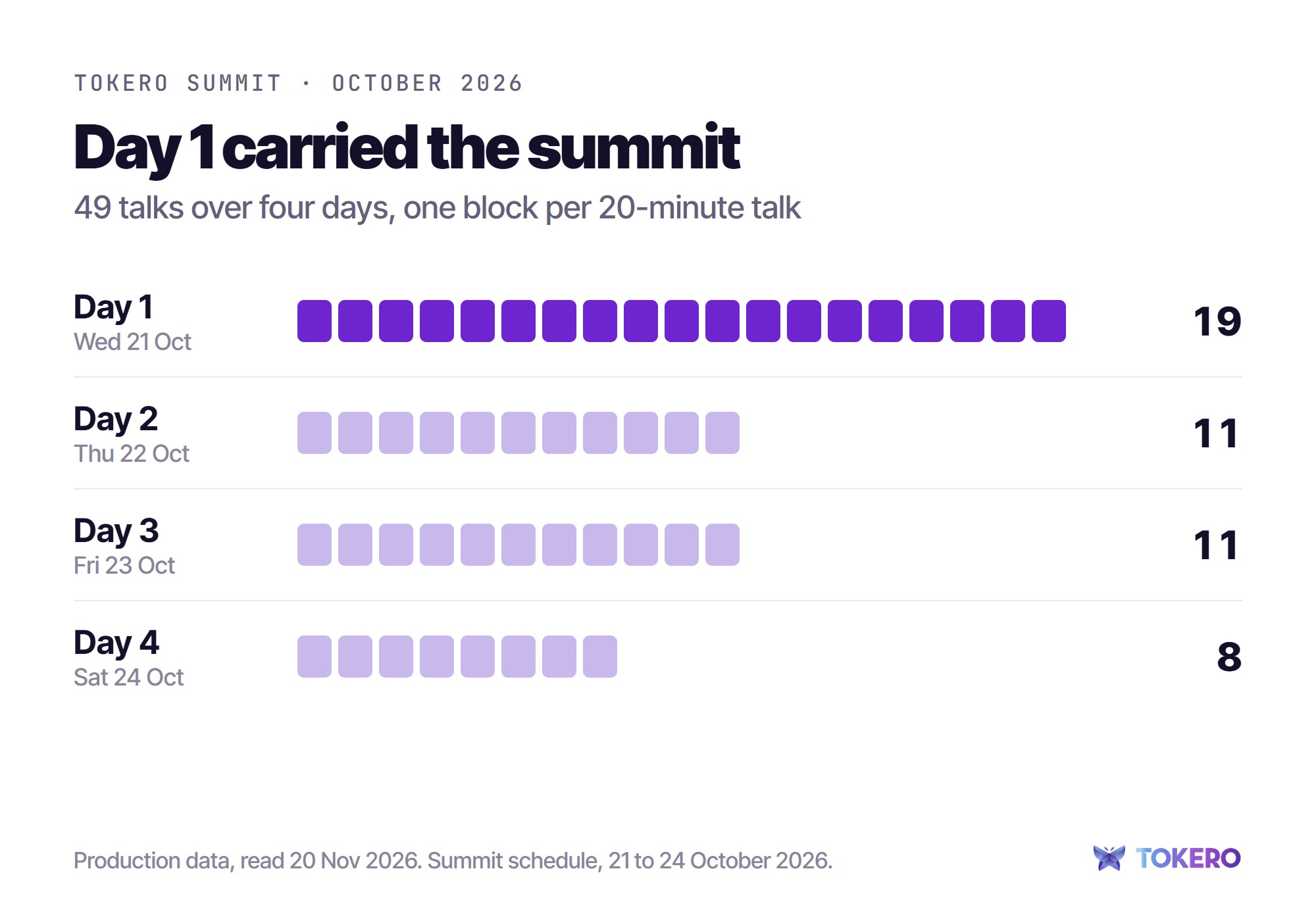
Talks per day at the October summit. Every talk was 20 minutes.
Two things stand out when you lay it out like that.
The first day carried the summit. Nineteen of the 49 talks, almost two in five, happened on day 1. The three days after it were shorter, and the last was the shortest.
Every slot was the same length. In March, talks ran between 15 and 20 minutes. In October, all 49 ran 20. No exceptions, no long keynote, no five-minute lightning round. 980 minutes of talks in total, a little over sixteen hours, cut into identical pieces.
Why identical slots matter more than they look
From the outside, a fixed slot length looks like a small detail. From where I sit, it's the thing that makes everything else easy.
When every talk is 20 minutes, the schedule is a grid. A speaker who can only do Thursday moves to Thursday, and nothing else on the page shifts. A viewer who wants to catch one particular talk can work out when it starts without reading anyone else's. And a talk that runs a minute over borrows from one neighbour, not from the whole afternoon.
It also changes the conversation with speakers. "You have 20 minutes" is a clear brief. Most good talks fit in it, and the ones that don't usually improve by being cut.
A smaller room, after the first day
Next to the stream there was a chat. Across the four days, 41 people wrote in it, 259 messages in all.
Day 1 had the busiest room: 118 messages from 27 people. On the next three days, about 45 to 50 messages a day, from a smaller group each time. That fits the shape of the programme: the biggest day had the biggest conversation.
The detail I like most: ten people came back to the chat on more than one day, and three wrote in it on all four. On an online event, where leaving costs one click, that's a small group of people who made the summit part of their week.
What I'd take from it, if you're planning one
If you're putting an online event together, here's what this one suggests:
- Pick one slot length and keep it. It turns your schedule into a grid, and your speakers' brief into one sentence.
- Put your weight on day 1. It's when the conversation is busiest. Plan the days after it to be shorter, not equal.
- Count the people who come back, not only the people who come. The ten who returned to the chat on another day tell you more about the event than any single day's peak.
- Give the conversation a place next to the talk. A chat beside the stream is where you find out who stayed.
If you want to be there for the next one, TOKERO is here.
If you've run an online event over several days, how did you decide what went on day 1?
Octavia Mateescu is a software developer at TOKERO, where she builds the tools creators use to publish and share their work across networks.
Figures: TOKERO production data, summit schedule and summit chat, read on 20 November 2026. Talk time is the number of talks times their 20 minutes. Counts only; no messages were read.
Previously: Crypto can fill itself in. The rest, people type by hand.
Also published on Medium.