
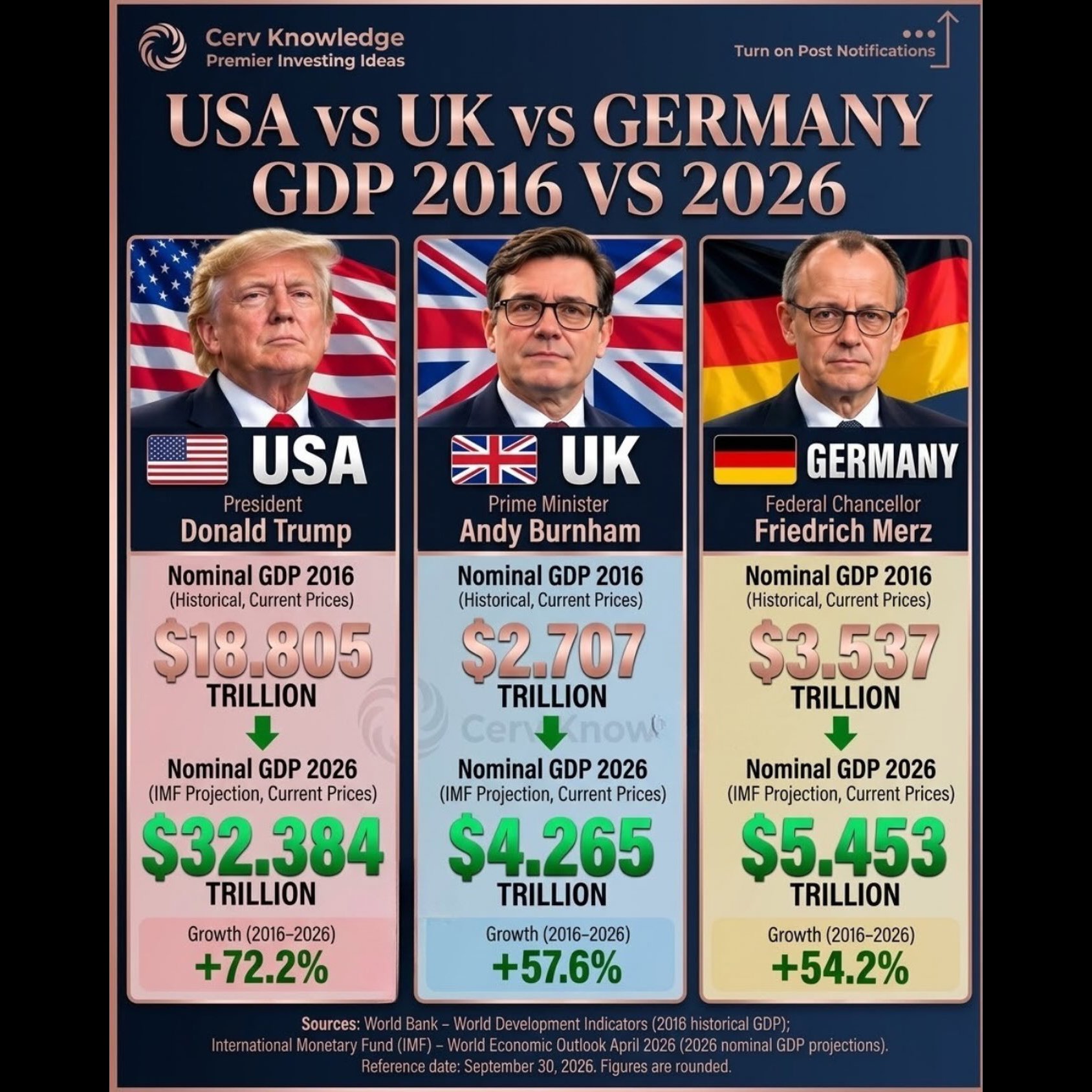
The U.S., UK and Germany have all experienced significant economic growth over the past decade.
From 2016 to 2026, the U.S. economy grew approximately 72.2% in nominal GDP, reaching a projected $32.4 trillion.
During the same period, the UK’s economy increased 57.6% to $4.3 trillion, while Germany’s grew 54.2% to $5.5 trillion.
GDP measures the total value of goods and services produced by an economy. However, nominal GDP growth also reflects inflation and exchange-rate changes, so it doesn’t necessarily mean living standards improved by the same percentage.
Follow @cervknowledge and check out my FREE Investing Guide (link in bio).
#GDP #USEconomy #GlobalEconomy #EconomicGrowth #investing

via
X
The UK economy grew 0.4% in Q2, with June GDP unexpectedly rising 0.3%, as consumers and businesses weathered the Iran war’s energy shock. But economists warn higher prices and borrowing costs could slow growth later in 2026. #UK #Economy #GDP #Oil
https://t.co/CbmbXRD50O
https://t.co/CbmbXRD50O
8


📉 A single country's data just pushed the Eurozone economy into contraction.
Ireland's GDP plunged 12.1% in Q1 2026, dragging the Eurozone from a previously estimated +0.1% growth rate to a -0.2% contraction.
But the headline doesn't tell the full story.
Ireland's economic figures are heavily influenced by multinational corporations and cross-border financial flows, making GDP exceptionally volatile and, according to some economists, nearly impossible to predict with precision.
What's particularly noteworthy is that excluding Ireland, Eurozone growth remained relatively stable at around 0.2% for the quarter. Meanwhile, inflation continues to run above the ECB's target, increasing the likelihood of further interest rate hikes despite signs of slowing growth.
Key takeaway: Economic data can sometimes obscure as much as it reveals. Looking beneath the headline numbers is essential for understanding the true health of an economy.
#Eurozone #Economy #GDP #Ireland #Inflation #ECB #Macroeconomics #EconomicOutlook #Finance #Markets
3
Tu as atteint la fin 🎉