

Meta might have one of the biggest advantages in the AI race, and it's not just its technology.
While OpenAI and Anthropic are spending billions building AI models and figuring out how to make them profitable, Meta already has something they don't: a massive advertising business generating revenue.
And that's a pretty big deal.
With its new Muse AI models gaining traction, Meta can use better AI to improve recommendations, keep people engaged longer, and help advertisers get better results.
More engagement means more ad revenue. More revenue means more money to invest in AI.
It's a cycle that could be difficult for competitors to match.
Of course, having a head start doesn't guarantee winning the race. But Meta isn't starting from zero, and that matters.
Could Meta end up being the biggest winner in AI without necessarily having the best AI model?
#Meta #ArtificialIntelligence #BigTech #TechStocks
2

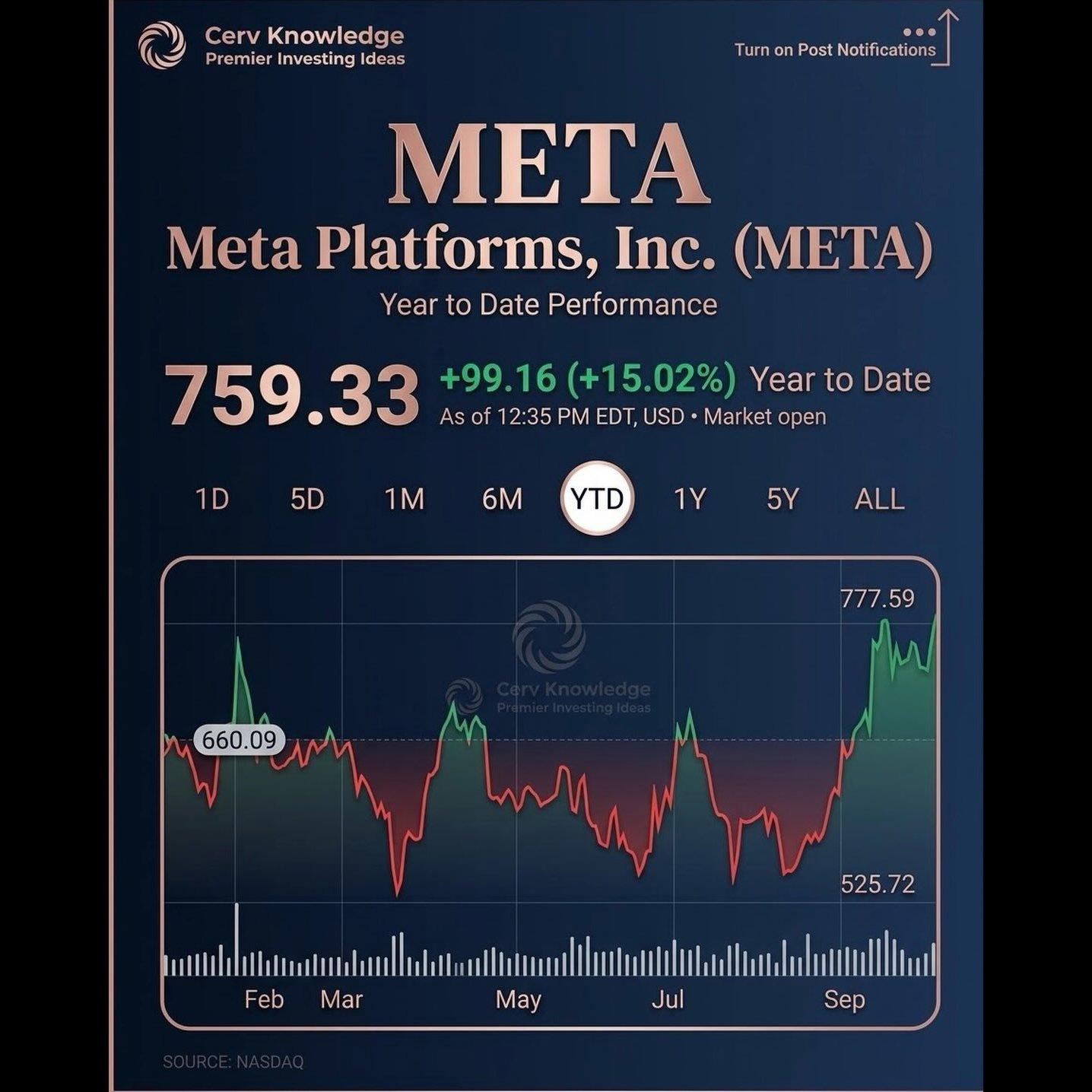
Meta (META) is gaining momentum as its latest AI developments attract Wall Street’s attention.
The company launched Muse Wonder and Muse Wonder Full, new AI models designed for coding, complex tasks and more advanced AI assistants.
JPMorgan raised its price target to $920, while Truist set a $1,000 target, reflecting optimism about Meta’s long-term AI opportunities.
Meta’s advertising business remains its biggest revenue driver, but its massive AI investments will need to deliver meaningful returns.
Are you buying META?
#META #MetaPlatforms #ArtificialIntelligence #GrowthStocks #longterminvesting

Last month, a new familiar face joined the S&P 500: Reddit. What does this mean for you? NOTHING! In fact, the S&P 500 swaps companies about 25 times a year and if you’re doing things right you won’t even notice. Going back to 1996, only 147 of the 500 companies on the S&P 500 list at the time are still included today. Index funds self-cleanse. Companies get booted off the list for all kinds of reasons. They shrink, get acquired, go bankrupt, or get replaced by the next big thing.
* “Buying Apple/Nvidia/Google/Whatever is a sure thing!” Why buy the “bad” stocks when you can just buy the gold-standard companies that are sure things? If I knew that, I’d have several yachts off the coast of Fiji. When you look through these lists, you realize that a “sure bet” of one decade may be the dying giant of the next. In 20 years, the top 10 will almost certainly look very different.
* “Tech giants have gotten too big.” Doomsdayers tell me how Nvidia, Apple, and Google alone make up over 20% of the S&P 500 and that “tech giants have gotten too big.” Well guess what? In 1973, IBM, AT&T, Exxon, Kodak, and GM made up 25% of the market. Since then, the S&P 500 has returned 27,029% (a CAGR of 11%).
That’s the “self-cleansing” nature of index funds. If you bought an index fund at the beginning of 1973, you would have realized a 27,029% return without doing any of the work of picking stocks. An index fund automatically adds the newest, fastest growing companies as they become big enough to be listed and drops the oldest/dying companies as they fall off the list. That means you always own the biggest and growing stocks in proportion to their size. If the tech giants of today aren’t going to be the biggest companies of the next decade, who will? Who cares! We own them all, and we'll benefit from the growth of every company.
As always, reminding you to build wealth by following the two PFC rules: 1.) Live below your means and 2.) Invest early and often.
- Jeremy & Jenn
Data source: dqydj.com, slickcharts.com
#sp500 #stockmarket #valuations #learntoinvest #indexfunds #topstocks #apple #microsoft #amazon #google #meta #nvidia
812
prin
X
AI marketing software company #Aizy has acquired fellow #Dutch industry player #Uptmz, with plans to create an integrated advertising platform for #Google, #Microsoft, and #Meta 🇳🇱🤝🇳🇱
https://t.co/wkMUlo9mgf
https://t.co/wkMUlo9mgf
6
Ai ajuns la finalul listei 🎉